My second anthology of the week.
Gene Wolfe may be the great living American writer. He's certainly the greatest American writer of speculative fiction. Wolfe's work is wonderfully layered and complex, without ever dragging or stumbling. Reading Wolfe requires work. He does not spoonfeed his readership. Pay close attention.
Let's start with the wrappings: this anthology has a delightful cover and a great title. I actually didn't notice the pun until I'd looked at the cover several times. Innocents Aboard perfectly captures the spirit of these short works, which often feature ordinary people thrust into extraordinary circumstances. The theme, if there is one, is the sense of wonder and strangeness evoked.
From the introduction I learn that Gene Wolfe is old enough to have a grandkid. This makes sense, but disappoints me, as my mental image of him is pegged at about 37 and smoking hot - a little bit like Neil Gaiman. Ah well, another fantasy down the tubes.
Inventive, clever, delightful, touching. Almost all allowed me to have that joyous moment of insight, the 'ah-ha!' moment when you figure it all out.
I'm still in awe at his craftsmanship, the way he gives his characters so distinctive a voice so quickly.
My favorite story was 'The Lost Pilgrim', but 'Queen' is the one that has stuck in my head the most.


Who wrote it?
Richard Mason brought up an excellent point. Forget fonts and cover illustrations; sometimes the publisher tries to trick the reader about who wrote the book.
There are a couple of variants on this:
1) Famous Author Presents. Publisher pays Famous Author beaucoup bucks to use his name on cover of book written by Up-and-coming Author. FA gets $$$, UA gets published, publisher makes more sales, everyone's happy except the reader who buys this book thinking it was written by FA.
For example:

Great big 'Isaac Asimov'. Little teeny John Barnes.
2) 'Collaborations'. Often books in a series, sometimes not, these are books co-written by one FA and one UA. Sometimes they are good, sometimes they are bad, sometimes they are awful. Who knows how much time the FA actually put into writing? Judging from some of the results, sometimes it's not very much time. It's hard to tell. While it does get the UA's name out there in front of fans, if it's a bad book, is that really good for their career?
For example, I loved the Carolus Rex books by Andre North and Rosemary Edghill (also known as Eluki Bes Shahar). I hated the Bedlam books by Edghill and Mercedes Lackey.


I love the way Edghill's name is hidden in the light-colored area on the Lackey cover.
I can't deny it's been very beneficial for some authors; for example, I remember seeing Elizabeth Moon's collaborations with Anne McCaffrey soon before Moon graduated to wide success in her independent work.

Here's another great collaboration cover. McCaffrey's name on top: Jody Lynn Nye's name on the bottom.

3) Ghostwriters. Did anyone really believe for a minute that William Shatner wrote the Tekwar series? Yet, there his name is. This was probably a 'work-for-hire' written by some UA who doesn't get either his name on it OR royalties. Not a good deal for him.

Worse, in terms of 'defrauding' the reader, are works 'by' a FA who has farms out his work to other people. The reader is expecting one level of quality and sometimes a very different level is delivered. There are persistent rumours about certain very high-volume authors who shall remain nameless.
Have you been burned by any particularly deceptive book covers, or particularly egregious 'collaborations'? Please share - I'll go browsing for some more covers today.
UPDATE: Here's a great one.

WHO wrote that?
There are a couple of variants on this:
1) Famous Author Presents. Publisher pays Famous Author beaucoup bucks to use his name on cover of book written by Up-and-coming Author. FA gets $$$, UA gets published, publisher makes more sales, everyone's happy except the reader who buys this book thinking it was written by FA.
For example:
Great big 'Isaac Asimov'. Little teeny John Barnes.
2) 'Collaborations'. Often books in a series, sometimes not, these are books co-written by one FA and one UA. Sometimes they are good, sometimes they are bad, sometimes they are awful. Who knows how much time the FA actually put into writing? Judging from some of the results, sometimes it's not very much time. It's hard to tell. While it does get the UA's name out there in front of fans, if it's a bad book, is that really good for their career?
For example, I loved the Carolus Rex books by Andre North and Rosemary Edghill (also known as Eluki Bes Shahar). I hated the Bedlam books by Edghill and Mercedes Lackey.
I love the way Edghill's name is hidden in the light-colored area on the Lackey cover.
I can't deny it's been very beneficial for some authors; for example, I remember seeing Elizabeth Moon's collaborations with Anne McCaffrey soon before Moon graduated to wide success in her independent work.
Here's another great collaboration cover. McCaffrey's name on top: Jody Lynn Nye's name on the bottom.
3) Ghostwriters. Did anyone really believe for a minute that William Shatner wrote the Tekwar series? Yet, there his name is. This was probably a 'work-for-hire' written by some UA who doesn't get either his name on it OR royalties. Not a good deal for him.
Worse, in terms of 'defrauding' the reader, are works 'by' a FA who has farms out his work to other people. The reader is expecting one level of quality and sometimes a very different level is delivered. There are persistent rumours about certain very high-volume authors who shall remain nameless.
Have you been burned by any particularly deceptive book covers, or particularly egregious 'collaborations'? Please share - I'll go browsing for some more covers today.
UPDATE: Here's a great one.
WHO wrote that?
Reading Journal Entry: The Girl Who Married A Lion, by Alexander McCall Smith
This week I will be reviewing short story collections. Gene Wolfe's Innocents Aboard, The Decameron, the James TipTree Award collection, and a BradBury collection.
To start things off I read this collection of African folk tales collected and in some cases modified by Alexander McCall Smith. He does admit to modifying them in the introduction, but doesn't provide any details.
When I was a kid I was addicted to fairy tales; the local library had a long shelf stuffed full of collections, and I read every one multiple times. These were, though, European or Arabian tales (many belonged to the Andrew Lang color collection.
These collected tales are firmly African. McCall manages to capture the cadence of truly rural stories well enough to be reminiscent of Chinua Achebe (which, I am proud to announce, I have been pronouncing correctly).
There's a 'Just-So' feel to some of these stories, but others veer from the expected path. The girl who married a lion, for example, didn't try to turn him into a prince or defend him from her family - nope, she knew he was going to eat her up one day, so he needed to go. Very practical. Many of the stories had familiar morals; stand by your family, be good to strangers, don't betray your friends.
The feel was very cinematic. I loved the story about the bird who gave milk.
This would be a great gift for fans of McCalls Detective Agency series. If your mom loves those books, get her this for her birthday.
To start things off I read this collection of African folk tales collected and in some cases modified by Alexander McCall Smith. He does admit to modifying them in the introduction, but doesn't provide any details.
When I was a kid I was addicted to fairy tales; the local library had a long shelf stuffed full of collections, and I read every one multiple times. These were, though, European or Arabian tales (many belonged to the Andrew Lang color collection.
These collected tales are firmly African. McCall manages to capture the cadence of truly rural stories well enough to be reminiscent of Chinua Achebe (which, I am proud to announce, I have been pronouncing correctly).
There's a 'Just-So' feel to some of these stories, but others veer from the expected path. The girl who married a lion, for example, didn't try to turn him into a prince or defend him from her family - nope, she knew he was going to eat her up one day, so he needed to go. Very practical. Many of the stories had familiar morals; stand by your family, be good to strangers, don't betray your friends.
The feel was very cinematic. I loved the story about the bird who gave milk.
This would be a great gift for fans of McCalls Detective Agency series. If your mom loves those books, get her this for her birthday.
Great Book: Metamorphosis, by Franz Kafka
I read one too many Kafka references and finally had to bump this to the top of the list, ahead of the current crop of GBs(Dante, Bocaccio, Aeschlyus, Arendt, Achebe - thank you SPL).
It's about a man who turns into a cockroach. What's not to like?
Wait. Sigh. OK. Here's where I confront my fears of sounding like an idiot because of other people already having said everything interesting about books like this.
Kafka seems to have had some kind of wide-ranging literary influence that I, frankly, have only heard about. Kafka, Kafka, Kafka! I expected Metamorphosis to be depressing. Instead it was depressing and amusing. Poor Gregor has a job he doesn't like and a family he doesn't seem to enjoy much either. At least when he turns into a giant bug it gives him another set of problems to worry about.
The intensity and minuteness of the experience leave no doubts - this is not a dream, this is really happening. Who hasn't feared that something like this would happen to them, or that it has already happened, and that we are giant despised liabilities to our families and friends. Haven't we all felt like vermin at some point?
There was some commentary at the back of the edition I read that discussed the religious metaphors and the paralells to tuberculosis. I think the intrinsic surface message of Gregor's transformation is far more interesting and poignant.
It's about a man who turns into a cockroach. What's not to like?
Wait. Sigh. OK. Here's where I confront my fears of sounding like an idiot because of other people already having said everything interesting about books like this.
Kafka seems to have had some kind of wide-ranging literary influence that I, frankly, have only heard about. Kafka, Kafka, Kafka! I expected Metamorphosis to be depressing. Instead it was depressing and amusing. Poor Gregor has a job he doesn't like and a family he doesn't seem to enjoy much either. At least when he turns into a giant bug it gives him another set of problems to worry about.
The intensity and minuteness of the experience leave no doubts - this is not a dream, this is really happening. Who hasn't feared that something like this would happen to them, or that it has already happened, and that we are giant despised liabilities to our families and friends. Haven't we all felt like vermin at some point?
There was some commentary at the back of the edition I read that discussed the religious metaphors and the paralells to tuberculosis. I think the intrinsic surface message of Gregor's transformation is far more interesting and poignant.
Can a cover trick a reader?
Can a cover 'trick' a reader?
My favorite cover snark artist doesn't think so.
"The back cover billed this book as a feminist-historical-fiction-fantasy hybrid. So, I thought "what the heck!" and purchased.
About 2 pages in - upon reading the physical description of the strikingly beautiful main character, Ariane, and the subsequent physical descriptions of her strikingly beautiful younger sisters - I realized I had been tricked! This book is more a Romance novel than anything else, albeit a slightly more substantial and far more engaging read than most "bodice rippers." "
How can a cover "trick" you? It's an inanimate object!
The above is a quote from the Amazon review of this book:
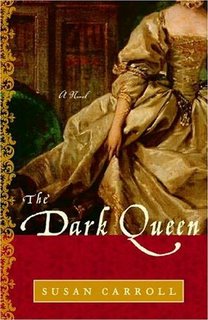
Covers can trick readers as much as movie previews can trick viewers. You see a preview (or a cover) and you expect a certain type of movie. That expectation can be misleading (egregious movie examples lately being, say, Stepmom - a downer about cancer disguised as a romantic comedy).
It's pretty clear to me that the above cover is meant to evoke the feel of the Dorothy Dunnett covers. Check out the font:
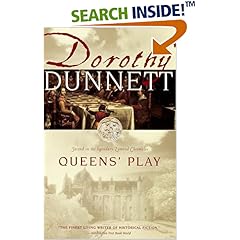
My question is (back to books), when is it a good idea? Will a publisher entice more readers than they alienate? Is it a good idea for publishers to put a 'historical fiction' cover on a romance? Is it 'cheating'?
My favorite cover snark artist doesn't think so.
"The back cover billed this book as a feminist-historical-fiction-fantasy hybrid. So, I thought "what the heck!" and purchased.
About 2 pages in - upon reading the physical description of the strikingly beautiful main character, Ariane, and the subsequent physical descriptions of her strikingly beautiful younger sisters - I realized I had been tricked! This book is more a Romance novel than anything else, albeit a slightly more substantial and far more engaging read than most "bodice rippers." "
How can a cover "trick" you? It's an inanimate object!
The above is a quote from the Amazon review of this book:
Covers can trick readers as much as movie previews can trick viewers. You see a preview (or a cover) and you expect a certain type of movie. That expectation can be misleading (egregious movie examples lately being, say, Stepmom - a downer about cancer disguised as a romantic comedy).
It's pretty clear to me that the above cover is meant to evoke the feel of the Dorothy Dunnett covers. Check out the font:
My question is (back to books), when is it a good idea? Will a publisher entice more readers than they alienate? Is it a good idea for publishers to put a 'historical fiction' cover on a romance? Is it 'cheating'?
Reading Journal Entry: Crossfire, by Nancy Kress
Damn!
These people make a colony on another planet, and then they find some aliens, and then they find some more aliens, and then things start getting pretty fucked up!
Awesome.
One of the most compelling things about this is the close-enough-to-taste near future setting. I could easily envision myself, in another lifetime, being one of these settlers.
Action + philosophy. What more could a science fiction fan ask for?
I'll definitely be reading the sequel.
These people make a colony on another planet, and then they find some aliens, and then they find some more aliens, and then things start getting pretty fucked up!
Awesome.
One of the most compelling things about this is the close-enough-to-taste near future setting. I could easily envision myself, in another lifetime, being one of these settlers.
Action + philosophy. What more could a science fiction fan ask for?
I'll definitely be reading the sequel.
Reading Journal Entry: Isabella, by Loretta Chase
Oh dear. I read this over the weekend and now I can't remember a thing about it.
Except that it was large print. Nice, large print.
I was really hoping for better from Ms. Chase!
OK, right, now I remember. Isabella is a well-dowered 26-year-old whose mother belonged to the ton before eloping with a merchant. This is the second eloping mother - I'm sending a theme.
Old scandal, appealing young female ward, mix in a titled nobleman or two, and voila! A pretty run of the mill category Regency.
Except that it was large print. Nice, large print.
I was really hoping for better from Ms. Chase!
OK, right, now I remember. Isabella is a well-dowered 26-year-old whose mother belonged to the ton before eloping with a merchant. This is the second eloping mother - I'm sending a theme.
Old scandal, appealing young female ward, mix in a titled nobleman or two, and voila! A pretty run of the mill category Regency.
Subscribe to:
Posts (Atom)